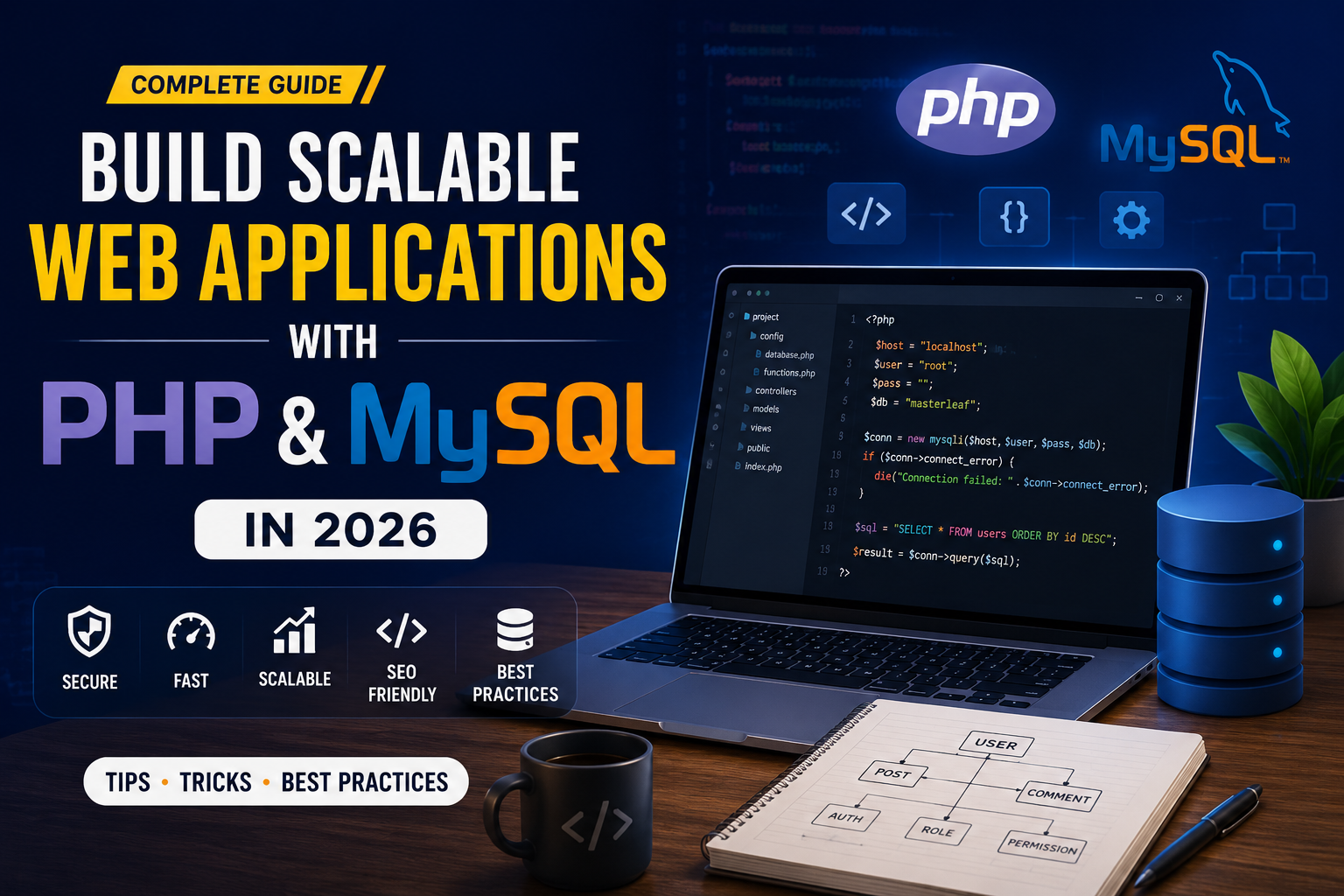
Every Developer Starts the Same Way
A few years ago, I built my first PHP project in a single file. Everything—from database connection to HTML, business logic, and form handling—was inside index.php.
At that time, it worked perfectly.
But after adding a few new features, fixing one bug created two more. Changing a simple function meant checking hundreds of lines of code. The project became difficult to maintain, and I realized something important:
Writing code is easy. Building software that grows with your business is the real challenge.
If you're building a school ERP, billing software, restaurant POS, CRM, or any custom business application, this guide will help you avoid the mistakes many developers make in the beginning.
Why PHP Still Powers Millions of Websites
Every year, new programming languages and frameworks become popular. Even then, PHP continues to power a huge portion of the web.
The reason is simple.
PHP is reliable, affordable, easy to deploy, and supported by almost every hosting provider. Combined with MySQL, it becomes a powerful solution for building secure and scalable web applications.
Whether you're creating a startup MVP or enterprise software, PHP still offers everything needed for modern development.
Don't Start Coding Immediately
One mistake many beginners make is opening VS Code and writing code without planning the project.
Before writing a single line of code, spend time answering questions like:
- What problem is this software solving?
- Who will use it?
- What modules will be required?
- How will users log in?
- How will data be stored?
- Can the application handle future growth?
Good planning saves hundreds of hours later.
Project Structure Matters More Than You Think
A clean project structure doesn't make your software look professional—it makes it easier to maintain.
Instead of keeping everything in one folder, organize your project properly.
app/
controllers/
models/
views/
config/
routes/
middleware/
helpers/
assets/
uploads/
public/
When every file has a clear purpose, adding new features becomes much easier.
A Fast Database Starts with Good Design
Many developers blame PHP when their application becomes slow.
In reality, the database is often the real problem.
A poorly designed table, missing indexes, or unnecessary queries can slow down even a powerful server.
Whenever possible:
- Use proper primary keys.
- Create indexes on frequently searched columns.
- Avoid duplicate data.
- Normalize tables where appropriate.
- Use prepared statements for every database query.
A well-designed database improves both speed and security.
Security Is Not an Optional Feature
Imagine spending six months building a project, only to have it hacked because user input wasn't validated.
Unfortunately, this happens more often than people realize.
Every production application should include:
- Password hashing
- SQL injection protection
- XSS filtering
- CSRF protection
- Secure session management
- Input validation
- File upload validation
Security should be built into the application from the beginning—not added later.
Users Notice Speed Before Features
You may have dozens of amazing features, but if your website takes six seconds to load, many visitors will leave before seeing them.
Performance isn't only about user experience.
It also affects Google rankings.
Some simple improvements include:
- Compressing images
- Lazy loading media
- Optimizing database queries
- Minifying CSS and JavaScript
- Enabling browser caching
- Reducing unnecessary HTTP requests
Small improvements often make a surprisingly big difference.
SEO Starts During Development
Many developers think SEO begins after the website is complete.
That's not true.
Good SEO starts while building the application.
Every page should have:
- A unique title
- A meaningful meta description
- Clean URLs
- Proper heading structure
- Structured data (Schema.org)
- Internal links
- Optimized images
- Mobile-friendly layout
These details help search engines understand your website more effectively.
Build for Future Growth
A project that works for 100 users may struggle with 10,000 users if scalability isn't considered early.
When designing your application, think ahead.
Can new modules be added easily?
Can additional developers understand your code?
Can the database handle larger datasets?
Scalable software isn't built overnight—it's the result of good architecture.
The Biggest Lesson
Over the years, one lesson has become clear.
Great software isn't created by writing more code.
It's created by writing cleaner, simpler, and more maintainable code.
The best developers don't just solve today's problem.
They make tomorrow's updates easier.
Final Thoughts
PHP and MySQL remain one of the most dependable technology stacks for building business applications in 2026.
If you combine clean architecture, proper database design, strong security practices, good performance optimization, and SEO-friendly development, you can create applications that are fast, secure, and easy to scale.
Technology will continue to evolve, but the principles of writing quality software remain the same.
Start with a solid foundation, think long-term, and focus on solving real problems. That's what separates a simple project from professional software.
Frequently Asked Questions
Is PHP still worth learning in 2026?
Yes. PHP continues to power many business websites, SaaS products, and enterprise applications. Modern PHP is fast, secure, and actively maintained.
Which database works best with PHP?
MySQL is one of the most popular choices because it's reliable, well-documented, and performs well for most web applications.
Is PHP suitable for large-scale projects?
Absolutely. Many large applications use PHP successfully when they follow proper architecture, caching, and database optimization practices.
How can I make my PHP application faster?
Focus on optimized SQL queries, caching, compressed assets, lazy loading, and clean code organization. Performance improvements usually come from many small optimizations rather than a single change.
Tags: PHP, MySQL, Web Development, Backend Development, Database Design, Performance Optimization, Security, SEO, Software Architecture, Programming
Comments & Discussions
Join the developer community discussion below.
No comments posted yet. Be the first to share your thoughts!
Leave a Comment